
 |
 |
  |
 |
 |

|
Article |
Put Some POW in your Access Technology |
|
|
Topic |
Law office technology |
|
|
Client |
Association of Legal Administrators |
|
|
Publication |
Legal Management |
|
|
Published |
March -- April 2003 |
|
|
Word count |
3,000 (340-word excerpt) |
Put Some POW in your Access Technology
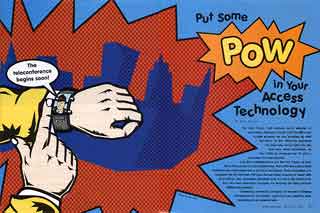
For Dick Tracy, that famous early adopter of technology, keeping in touch with the office was a high priority, as was keeping up with the times. In the 1960s, he upgraded his two-way wrist radio for the two-way wrist TV. In the 1980s, he replaced the TV with a computer, the wrist Geenee.
Today, technology permeates every aspect of the law practice. Case information is stored in databases. Databases are accessed via the Internet. Wireless devices are keeping lawyers in touch with their offices. The ubiquitous TV is in full use in the courtroom. And two-way TV gadgets are helping far-flung branch offices stay in touch.
 To complicate matters, technology constantly changes. Evaluating, upgrading and adopting new technology is an ongoing task.
Practice and Litigation Support
Alston & Bird LLP keeps pace with change. A recognized leader in adopting and using technology in their law practice, the firm ranked third in AmLaw Tech's 2002 Tech Scorecard.
Trial technology is one area that Alston & Bird was content to outsource until about five years ago, according to Nill Toulme, the chairman of the firm's technology committee and who practices law on the side. He says, "As litigation has become bigger in the last 10 to 20 years, the ability to handle huge quantities of documents, and more recently, online databases, has become critical. You can't rely entirely on outside vendors for that. So you have to have a certain level of in-house expertise to be responsive at 3 a.m. while a trial is going on, and also to help you manage outside vendors most effectively."
Toulme says that not all litigation requires massive personnel and technology support. But, he says, big litigation, which can spawn hundreds of thousands of documents, benefits from filing documents in a centralized database. It's simply not possible for people in different offices and firms to access all of these documents as hard copies.
For example, he says that a large product liability case involving more than one firm and jurisdiction will run more efficiently with a centralized, organized online database of case documents and relevant legal and scientific information so that decentralized clients and counsel have access to the same information.