
 |
 |
  |
 |
|

|
Article |
From Humble Origins |
|
|
Topic |
History |
|
|
Publication |
The Shield |
|
|
Published |
Summer 1996 |
|
|
Word count |
3000 (465-word excerpt) |
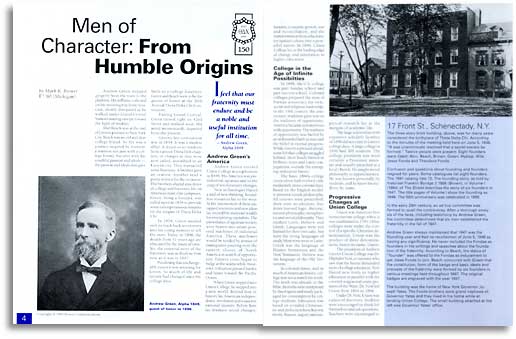
Men of Character: From Humble Origins
Andrew Green stepped gingerly from the train to the platform. His stiffness, collected on his morning trip from Syracuse, slowly dissipated as he walked under Grand Central Station's soaring canopy toward the light of midday.
 Abel Beach was at the end of Green's journey to New York City. Beach was an old and dear college friend. So his was a journey inspired by reunion: a reunion not just with a college friend, but also with his youthful passion and ideals — the passion and ideas that gave birth to a college fraternity. Green and Beach were to be the guests of honor at the 50th Annual Theta Delta Chi Convention.
Exiting Grand Central, Green turned right on 42nd Street and walked west. His mind momentarily departed from the present.
Green's last convention was in 1854. It was a modest affair. A dozen or so students from various Theta Delt chapters, or charges as they were now called, assembled in an Eastern city. They transacted some business. A brother gave an oration. Another read a poem written for the occasion. The brothers shared anecdotes of college and fraternity life on America's most elite campuses. Green, being a founder, was called up in 1854 to provide some extemporaneous remarks on the origins of Theta Delta Chi.
In 1854, Green needed only to reach back seven years into his young memory to tell the story. Today, in 1898, the details from 51 years ago are obscured by the mists of time. Yet, the essential story of the fraternity was as fresh to him now as it was in 1847.
Pondering this unchangeable essence was amusing for Green. So much of life and society had changed since his college days.
Andrew Green's America
Andrew Green entered Union College as a sophomore in 1846. His America was pre-industrial, agrarian and on the cusp of revolutionary changes.
New technologies blazed a trail of new thinking. Boundless resources lay to the west. At the intersection of these untapped resources and new ideas lay incredible material wealth for enterprising capitalists. The plowshares of agrarian society were beaten into steam-powered machines of industrial America. These machines would be tended by armies of immigrants pouring over the eastern shores of North America in search of opportunity. Eastern cities began to bulge at the seams while Western Civilization pressed harder and faster toward the Pacific Ocean.
When Green stepped into Union College, he stepped into a new world. Behind him in history lay American independence, revolution and a nascent national identity. Before him lay dramatic social changes, fantastic economic growth, war and reconciliation and the transformation from a backwater upstart colony into a powerful nation. In 1846, Union College lay at the leading edge of change and innovation in higher education.