
 |
|
  |
 |
 |

|
Article |
Delayed Gratification |
|
|
Topic |
Racecar restoration |
|
|
Publication |
FORZA magazine |
|
|
Published |
April 2005 |
|
|
Word count |
2600 (425-word excerpt) |
Delayed Gratification
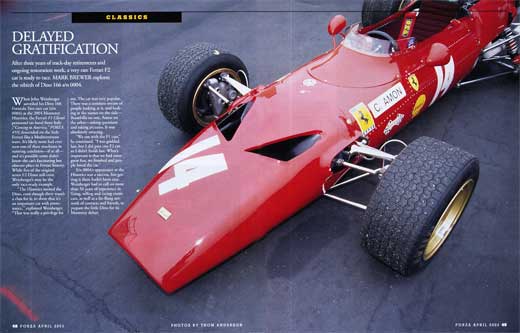
When John Weinberger unveiled his Dino 166 Formula Two race car (s/n 0004) at the 2004 Monterey Historics, the Ferrari F1 Clienti personnel on hand from Italy [“Coming to America,” FORZA #59] descended on the little Ferrari like a Mediterranean wave. It’s likely none had ever seen one of these machines in running condition—if at all—and it’s possible some didn’t know the car’s fascinating but obscure place in Ferrari history. While five of the original seven F2 Dinos still exist, Weinberger’s may be the only race-ready example.
“The Historics invited the Dino, even though there wasn’t a class for it, to show that it’s an important car with provenance,” explained Weinberger. “That was really a privilege for me. The car was very popular. There was a constant stream of people looking at it, and looking at the names on the side—Brambilla on one, Amon on the other—asking questions and taking pictures. It was absolutely amazing.
 “We ran with the F1 cars,” he continued. “I was gridded last, but I did pass one F2 car, so I didn’t finish last. What’s important is that we had some great fun, we finished and people loved the car.”
S/n 0004’s appearance at the Historics was a success, but getting it there hadn’t been easy. Weinberger had to call on more than 50 years of experience in fixing, selling and racing exotic cars, as well as a far-flung network of contacts and friends, to prepare the little Dino for its Monterey debut.
Formula Two may be best remembered for its heyday in the early 1950s, when rising development costs and shrinking grids prompted the FIA to abandon the Formula One specification and run F2 cars in the 1952 and ’53 World Championships. Alberto Ascari won the title both years driving a 2-liter four-cylinder Ferrari 500 F2.
World Championships aside, F2 served as a support series for F1 from 1948 and 1984. In the early days, it was a “small-car class” to the Grand Prix machines, and the factory F1 drivers regularly drove the smaller, lighter and less powerful F2 cars. In later years, F2 became a feeder series, where future F1 pilots like Eddie Cheever, Patrick Tambay and 1981 World Champion Keke Rosberg got their start.
S/n 0004 was built for the 1967 F2 season with a mid-mounted twin-spark 65° V6 with twin overhead cams and three valves per cylinder—two intake and one exhaust. Displacing 1,596cc, the motor produced 200 bhp at 10,000 rpm, redlining at 10,500. A five-speed transmission delivered power to the rear wheels.